
Child Characteristics
The breakdown of the I-ASC explanatory model shows a range of factors that should be considered in AAC decision making. These child characteristics include physical abilities, intrinsic traits, and factors related to the child’s experiences with AAC over time.
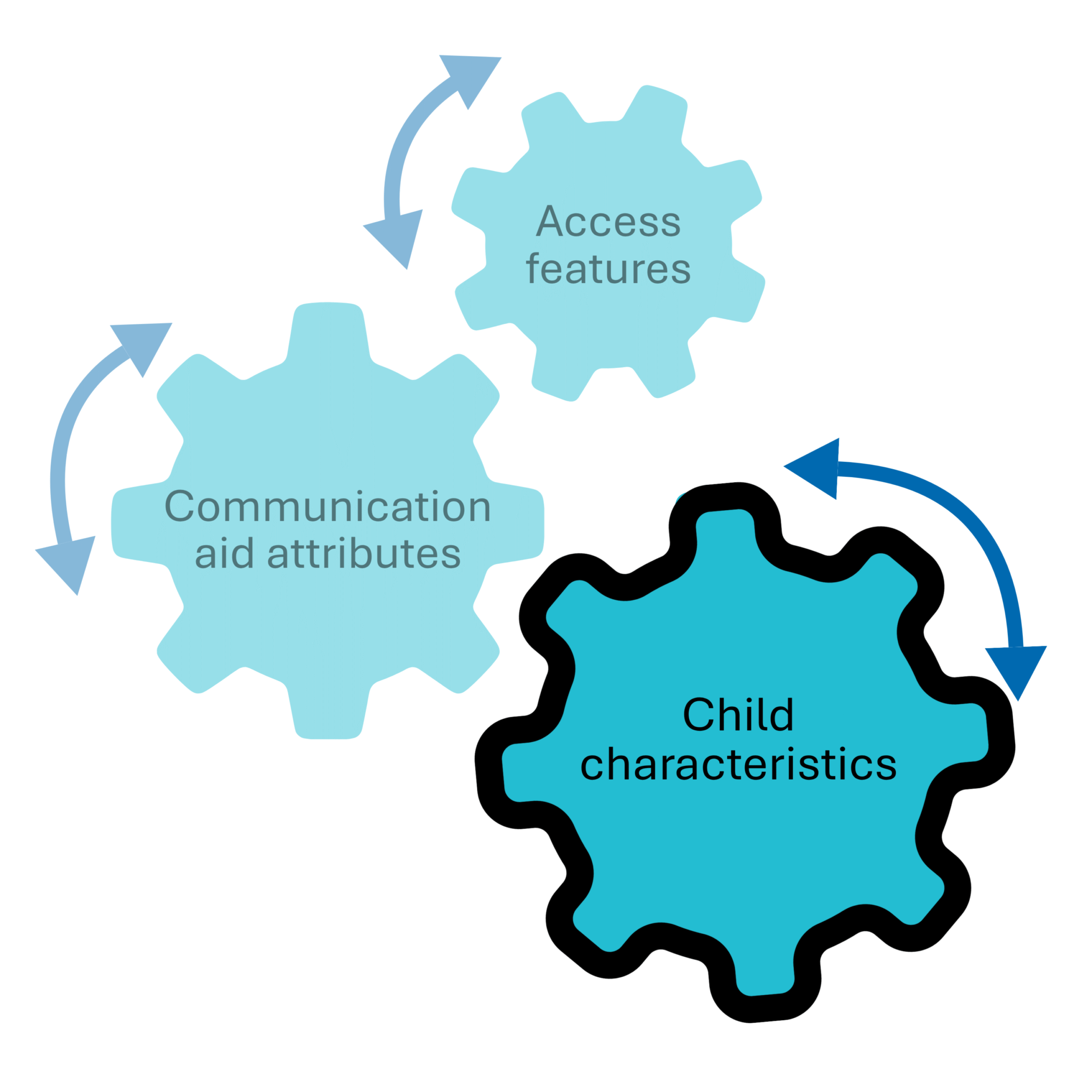
The elements that make up ‘Child characteristics’ are explained below – click on each heading to learn more
Please note: In this section, the term “child” is used broadly and may refer to an AAC user of any age. The original study was conducted with children and young people, however we have had considerable feedback that with a little modification of the content provided, there is relevance to individuals across their lifespan. We encourage you to consider minor adaptations to better suit your context.
Age
What does this term mean?
This refers to the child’s actual age in years. It may be different from their current level of development or what they are able to do. This research suggests that people often compare a child’s chronological age with their developmental level. This comparison can shape expectations about the child’s current progress and what they may achieve in the future.
Things to consider
A detailed assessment of a person’s language and communication skills is an important part of making recommendations. Using standardised assessment tools in combination with informal observation ensures a comprehensive understanding of what they can do.
For some children who need AAC, it helps to consider their chronological age. For example, following assessment an 8 year old child may have the language and communication skills closer to that of a 3 year old child. Ensuring the child’s language opportunities are developmentally appropriate can help support their communication and language growth.
Consider the child’s age when choosing the vocabulary system. It may be helpful to take a developmental perspective. Here you choose a system that offers a level of language that suits current abilities but also promotes the young person’s development towards increased language complexity.
From the beginning, children require their AAC systems to be available across the day. Incidental opportunities for language learning happen at anytime and all the time.
- No matter the age, the young AAC user needs a plan to support them develop their AAC skills. Finding highly motivating communication opportunities will help them become more resilient in using any AAC system – all of them are more demanding than just ‘talking’.
All AAC users will grow up. It is helpful to think about what will work for them as they become adolescents – especially when choosing new vocabulary.
Tools and materials
Assumed abilities
What does this term mean?
This considers how a child’s abilities, interests and motivations are understood. Care should be taken to ensure these are explored accurately, as a child’s abilities may be overestimated or underestimated.
Things to consider
Gather all relevant information, including formal and informal assessments, before making decisions about a child’s abilities. Understanding their comprehension of language is a key part.
If information is missing, it is important to think about how this could affect the decisions being made.
Be mindful of assumed roles and responsibilities, and make sure expectations for each person are clearly explained.
Provide opportunities to discuss expectations and assumptions to ensure all information is collected and considered before making a recommendation.
Tools and materials
Child's preference
What does this term mean?
This considers the child’s views of communication systems or ways of communicating.
Things to consider
Incorporate child and young person preferences and perspectives in the AAC assessment and ensure they are reflected in decision-making.
Identify what motivates the child to use technology, or to communicate in anyway they choose.
Check with the child or young person that you have understood their preferences correctly, and work together to support any differences in opinions.
Ensure communication aid trials are evaluated objectively so that child preferences are fully understood and inform decisions effectively.
Tools and materials
Cognitive skills
What does this term mean?
This characteristic considers information about the child’s general cognitive skills, including attention, memory, focus, learning style, and insight. How these skills are viewed can influence decisions about what communication support is offered and when. I-ASC research findings suggest the need to understand the influence of cognition on communication.
Things to consider
Introduce AAC as early as possible to support understanding and expressive language development.
Use an appropriate standardised assessment to understand a child’s cognitive abilities. This is particularly important when these skills affect what services or support they can access.
While children are learning how to use AAC systems with higher cognitive demands, offer AAC scaffolding supports with lower operational demands. This will promote language and communication development.
Think about both the limits and the learning opportunities offered by the graphic representation system you choose.
- Try to use one type of graphic system to support learning and consistency.
Only change the system if it better meets the individual child’s needs.
- Avoid making changes for reasons that are not linked to the child.
Tools and materials
Communication ability
What does this term mean?
Here, both aided and unaided communication abilities are considered. This includes communication using gestures, facial expressions, signs or speech, as well as communication using aids such as communication books or speech-generating devices. I-ASC research findings suggest that the child’s communication abilities need to be considered across different contexts and when interacting with different people.
Things to consider
Find out how the child communicates in different places, such as at home, at school and in other settings.
Make sure any communication support or tools you recommend work well with how the family already communicates.
Find opportunities for the child or young person to learn how to use their AAC system, and support them to work towards agreed goals.
Identify how different ways of communicating (for example, speech, gestures, or AAC) are used and prioritised in different places, such as at home or at school.
Encourage the child or young person to communicate by using activities that interest and motivate them.
Help families understand the progress that can be made when the right AAC support is in place.
Use a range of communication methods (such as speech, signs or AAC) to support quick and natural social interactions.
To avoid limiting children’s opportunities to develop their AAC communication skills, they should not be required to show their communication ability before trying an AAC system as part of the recommendation process.
Tools and materials
Diagnosis
What does this term mean?
This refers to any medical or speech and language diagnosis the child or young person may have. I‑ASC research suggests that a child’s diagnosis can shape expectations about them. This can influence decisions about access to services, the type of system chosen, how it is accessed, and how vocabulary is organised.
Things to consider
Think about the child or young person’s speech, language and communication skills. Use any available information about their diagnosis to inform your decisions. For example, consider social communication in children with autism.
Consider how other features linked to a diagnosis may affect communication. This may include physical skills, movement, sensory needs, and reflex responses.
Use referral and diagnostic information to help plan which professionals should be involved in the AAC symbol communication assessment.
Tools and materials
Expectations and aspirations
What does this term mean?
This describes the child’s future journey with AAC. It includes likely needs, goals for AAC, hopes, and aspirations. I-ASC research findings suggest that expectations about the future can influence decisions about the support recommended now.
Things to consider
Choose an AAC system that meets the child or young person’s current needs and can also grow with them over time.
Keep high expectations for all children and young people.
If progress has been slow, think about the communication opportunities they have had so far. Focus on how to improve future opportunities, rather than limiting expectations based on past progress.
Support AAC recommendations with goal setting that aims to build communication skills across communication and learning contexts.
Include sufficient discussion and consensus building during the AAC assessment so that everyone agrees on shared goals and understands the plan.
Intervention plans should support the child or young person to have frequent opportunities, in a range of situations, to communicate with different people.
- Provide opportunities for children to see and learn from AAC role models, helping them to build confidence and positive expectations for themselves.
Tools and materials
Linguistic level
What does this term mean?
This refers to the child or young person’s current language skills, including their understanding and use of language, literacy and knowledge of graphic symbols. I-ASC findings suggest that there is often not enough detail at the time of assessment to clearly describe what the child understands and how they express themselves.
Things to consider
All AAC assessments should include clear summaries of the child’s language skills. These should be based on what has been observed and describe how much information they can understand in a sentence, or what concepts they can express using a sequence of related ideas. For example, graphic symbol sequence /hot/ + /Cereal/ = porridge.
Where possible, include results from formal (standardised) language assessments. These can be used as intended or adapted to describe the child’s understanding and expression.
Professionals should work together to gather this information, rather than assuming it is the responsibility of one service.
Where children’s physical challenges impact on access to AAC vocabularies, ensure specific communication opportunities with lower physical access demands. For example, providing opportunities to use repeated line Social Scripts for social conversation or use partner assisted scanning.
Support the child to develop skills in choosing the best way to communicate for different situations and people. This is known as strategic competence.
AAC goals should highlight language development and communication development as separate but complementary areas.
Provide drill and practice activities and real life opportunities to use and develop language and communication skills.
- Provide AAC supports and strategies to facilitate literacy development.
Keep high expectations for the child’s language development and do not require them to show ability before they can access AAC learning opportunities.
Tools and materials
Motor abilities and operational competence
What does this term mean?
This section includes consideration of physical skills, mobility and speech intelligibility (how clearly a child’s speech can be understood). The research findings suggest that a child’s motor and operational abilities (their physical skills and ability to use and navigate a communication aid) can influence which communication aid is recommended.
Things to consider
Provide more time within learning opportunities for children with physical limitations so that they can actively participate.
Be aware that slower ways of accessing communication can affect motivation for both the child and their communication partner.
Provide other communication opportunities that are fast and place less physical demand on children.
Balance long-term aims for independent communication with how difficult a system may be to use. Supported or shared communication may be a helpful step.
When access needs are complex, involve the right professionals and keep a strong focus on language and communication outcomes.
Be mindful of team member preferences and aim to achieve consensus when choosing an access method.
Provide specific opportunities to develop access skills and provide separate language and communication learning opportunities.
Aim to gather as much information related to physical and visual skills as possible to avoid making decisions with information gaps.
Where setting up the AAC system takes time (e.g. such as with eye gaze systems), provide other AAC supports for spontaneous communication.
Offer opportunities to practise navigating the system outside of real conversations, so the child can focus on learning how it works.
Tools and materials
Personality and temperament
What does this term mean?
A child’s personality and temperament, including things like what motivates them and what frustrates them play an important role when choosing a communication aid. The research shows that these traits are taken into account during the decision‑making process, and may influence how the child uses the aid.
Building a child’s confidence with AAC starts by helping them feel comfortable, motivated, and proud of their early communication attempts. You can strengthen their willingness to keep going by reducing frustration and creating plenty of positive experiences.
Things to consider
Boosting confidence — Support the child so they feel good about trying AAC, and encourage them to keep practising even when it’s challenging.
Minimising frustration — Introduce AAC demands gradually, so the child isn’t overwhelmed.
Building motivation — Give the child quick, early wins so they experience success and want to communicate more.
Creating positive early experiences — Make early intervention fun and rewarding, helping the child enjoy communicating and feel eager to do it again.
- Understanding personality — Spend time during assessment getting to know the child’s personality and preferences. Use this insight to shape recommendations and design AAC systems that feel personal and meaningful to them.
Tools and materials
Progress and communication opportunities
What does this term mean?
Having a communication aid can open up new opportunities for a child because people often change how they interact with them once the aid is introduced. The research shows that many children benefit from a longer trial period before a final recommendation is made. This gives them time to develop the skills needed to use the aid and lets professionals see how the child communicates in real‑life situations. These real interactions provide valuable practice and help inform recommendations based on genuine learning experiences, shaping future planning.
Things to consider
Trial periods should be guided by strong formal and informal assessment. Keep the AAC system available at all times so the child can explore and practise, and avoid limiting use to certain settings. Provide communication opportunities regardless of skill level—some children need more time, encouragement, and scaffolding to grow.
Introduce AAC early and create structured chances to communicate with familiar partners. Set clear, objective goals for any loan period that reflect the child’s learning style. Stay aware of service routines that may restrict AAC options, and offer peer mentoring when possible.
Support both off‑line practice (building language skills) and on‑line practice (using AAC in real interactions with mixed communication methods). Provide varied communication opportunities—questions, descriptions, jokes, stories—and allow mistakes as part of learning.
Plan for the future: ensure the AAC system can grow with the child and remain available long‑term. Be clear about who has the expertise to support ongoing AAC development and who may need training.